Local Service Business Lead Generation: 10 Strategies to Try
Local service businesses often ask the same question: Where will the next customer come from?
Waiting for referrals can leave your schedule up to chance, especially during slower months. A better plan is to use several lead sources that work together to bring in new jobs more often. You don’t need a huge marketing budget to make that happen.
In this article, you’ll learn the best local service business lead generation methods.
TL;DR
These are the best strategies:
Optimize your Google Business Profile
Invest in local SEO
Create dedicated service area pages
Run Google Local Services Ads
Build trust with customer reviews
Launch a customer referral program
Partner with complementary local businesses
Build an email marketing list
Publish helpful local content
Monitor social media like Facebook groups using Groups Watcher
Common Challenges Local Service Businesses Face
Local service businesses deal with more than finding new customers. Daily work, rising costs, and strong competition can make growth much harder than expected.
Here are some of the most common problems:
Managing home service businesses becomes much harder when you accept more jobs than your team can finish.
Breaking into the local market takes time because many companies compete for the same neighborhoods and use similar marketing messages.
Finding skilled workers remains difficult, and empty positions often force you to delay appointments or turn down new jobs.
Many independent business owners handle field work, customer calls, and paperwork on their own, which often leads to burnout.
Your online reputation can suffer after one bad customer experience, especially if it results in a negative public review.
A small marketing budget disappears quickly when you spend money without tracking which channels actually bring in new customers.
10 Effective Local Service Business Lead Generation Strategies
The best results usually come from several lead sources that work together. Here are 10 different strategies you can try:
1. Optimize Your Google Business Profile
A Google Business Profile helps your business appear in Google Search and Google Maps, including the Local 3-Pack, the three featured businesses that appear above regular website links. People often choose one of those listings before they visit any website.
Get high intent leads from Facebook groups.
Turn Facebook groups into a lead source for your business. Book a demo to see if it fits.
Book a demoStart with your NAP: name, address, and phone number. Write that information exactly the same on Google, your website, Facebook, Yelp, and every other directory.
If you use “St.” on one page, don’t change it to “Street” somewhere else. Google compares those details to confirm your business is legitimate.
Choose one primary category that matches your main service, then add secondary categories that describe your other services. Keep your business hours updated, including holiday hours. Add real job photos, turn on messages to enable customers to contact you, and reply to reviews often.
Those updates help potential customers trust your business and show the local community that you stay active. Real photos make your marketing campaigns feel more believable, too.
2. Invest in Local SEO
Unlike paid ads that stop the moment you stop spending money, local search engine optimization (SEO) can keep bringing visitors for months or even years.
Start with local keywords that combine your service and city, such as “roof repair in Tampa.” Those searches have strong local intent because people usually need help nearby.
Next, edit your page titles and meta descriptions. Those are the short lines people see on Google before they open your website. Include your main service, city name, and phone number when they fit naturally.
Search engines further read hidden website code to understand your business. Fast-loading pages, mobile-friendly design, and clear contact information support your search engine optimization work.
Add a Google Map to your contact page by:
Opening Google Maps
Clicking “Share”
Selecting “Embed a map”
Copying the code into your website
Those updates help your pages rank higher in search engine results pages.
3. Create Dedicated Service Area Pages
Many homeowners search for businesses in their own town. A search like “plumber in Round Rock” tells Google exactly where that person wants service. Pages built for specific locations help your website match those searches.
Create one page for every city or neighborhood you serve, and write original content for each. Mention nearby schools, parks, or major roads to improve local visibility.
Aside from that, add a short section that explains your service area, such as “We proudly serve homeowners throughout Round Rock, from homes near Old Settlers Park to businesses along Interstate 35.”
Each page should also include contact information, a booking form, and a Google Map that shows your service area. These pages expand your reach beyond your immediate local area, face less local search competition than larger cities, and attract potential customers who want proof that you travel to their neighborhood.
4. Run Google Local Services Ads
Google Local Services Ads place your business above regular search ads. Customers can call, message, or book a service directly from the listing.
Traditional ads charge you every time someone clicks. The pay-per-lead model, on the other hand, only lets you pay when someone contacts your business through the ad.
To start, complete Google’s verification process, choose your service area, and connect your Google Business Profile. Then pick “Maximize Leads” if you want Google to manage bidding automatically, or choose “Custom Bid” if you want to set the highest amount you will pay for a lead.
Review your ad spend often, track leads in the dashboard, and adjust your local campaigns when needed. Google can even identify approved businesses as verified local service providers, which helps customers trust your business before they call.
5. Build Trust With Customer Reviews
Reviews often influence a customer’s decision before they contact your business. Leads want proof that your team arrives on time, treats their property with respect, and finishes the job correctly.
Ask for a review as soon as the job ends because fresh feedback creates a steady stream of new reviews that tells Google your business stays active. And since reviews contain real words that customers use to describe your work, they can improve your visibility in Google search results.
Strong ratings help you earn more local leads and attract high-quality leads because many homeowners choose trusted businesses instead of the cheapest option. As your profile collects more positive reviews, your business often receives more leads.
6. Launch a Customer Referral Program
People trust recommendations from friends and family more than advertisements. A customer who hears, “We used this company last month, and they did a great job,” already has confidence before making the first call.
You can do a “give and get” reward to encourage new customers to book while giving existing customers a reason to recommend your business to more people. For example, give your existing customer a $25 credit after their friend completes the first job, then give the friend $25 off that first visit.
Track every referral in your customer relationship management system so you know who recommended each customer. Your marketing spend also stays low because you only pay the reward after you receive payment.
Small marketing efforts like that can turn satisfied customers into one of your strongest sources of local lead gen and bring you more customers over time.
7. Partner With Complementary Local Businesses
Some of your best referrals can come from businesses that serve the same homeowners but offer different services.
A roofer, for example, may work well with a gutter company. Nobody competes for the same job, yet both companies meet the same customers.
Choose a strategic partner with a good reputation and agree to recommend each other when the opportunity comes up. Many local business owners already receive questions outside their own trade.
You can also exchange brochures, link to each other’s websites, or mail postcards together. Working with other local businesses helps more people recognize your company. A dedicated partner may even split printing costs or host free local events, such as home maintenance workshops before summer or winter.
8. Build an Email Marketing List
Your email list belongs to your business. Social media platforms can change their algorithms at any time, but your subscriber list stays yours.
You need to give people a reason to subscribe. A discount, seasonal checklist, or simple home maintenance guide usually works better than asking people to “Join our newsletter.” Send useful tips most of the time and promotional emails only when they fit the season.
Regular lead nurturing keeps your business in people’s minds until they need help. That approach removes the need for cold calling because subscribers have already chosen to hear from you.
Many companies use digital marketing software to send welcome emails, seasonal reminders, and follow-up messages automatically.
9. Publish Helpful Local Content
Many homeowners search online before they call a contractor. They want to understand the problem first, even if they plan to hire someone later. Content marketing gives your business a chance to answer those questions before another company does.
Write articles based on questions your target audience already asks. As a plumber, you could publish “Why does my water heater make popping sounds?” If you’re an HVAC company, explain “How often should I replace my air filter?”
Add examples that fit your town because your local audience wants advice that matches local weather and common home problems.
Helpful articles, in addition, build brand awareness, making your business appear more often when homeowners search for answers.
10. Monitor Social Media
People often ask on social media, especially on Facebook, for recommendations before they search Google. A post like “Can anyone recommend a plumber in Plano?” can receive several replies within minutes. The first helpful response often gets the most attention.
Social media marketing starts with listening. Join local Facebook groups, watch neighborhood discussions, and reply when local customers ask for recommendations. Helpful answers can generate local leads without paying for social media ads.
Checking groups by hand every day takes time, especially if you belong to dozens of communities.
Groups Watcher monitors your selected private and public Facebook groups for you and sends an alert when someone publishes a post that matches your keywords.
Faster replies strengthen your local lead generation strategies and help you connect with more qualified leads before competitors join the conversation.
Refreshing Facebook all day doesn’t mean you’ll see every post. Let Groups Watcher monitor your selected groups and notify you the moment matching posts go live!
Get Ahead in Local Lead Generation With Groups Watcher
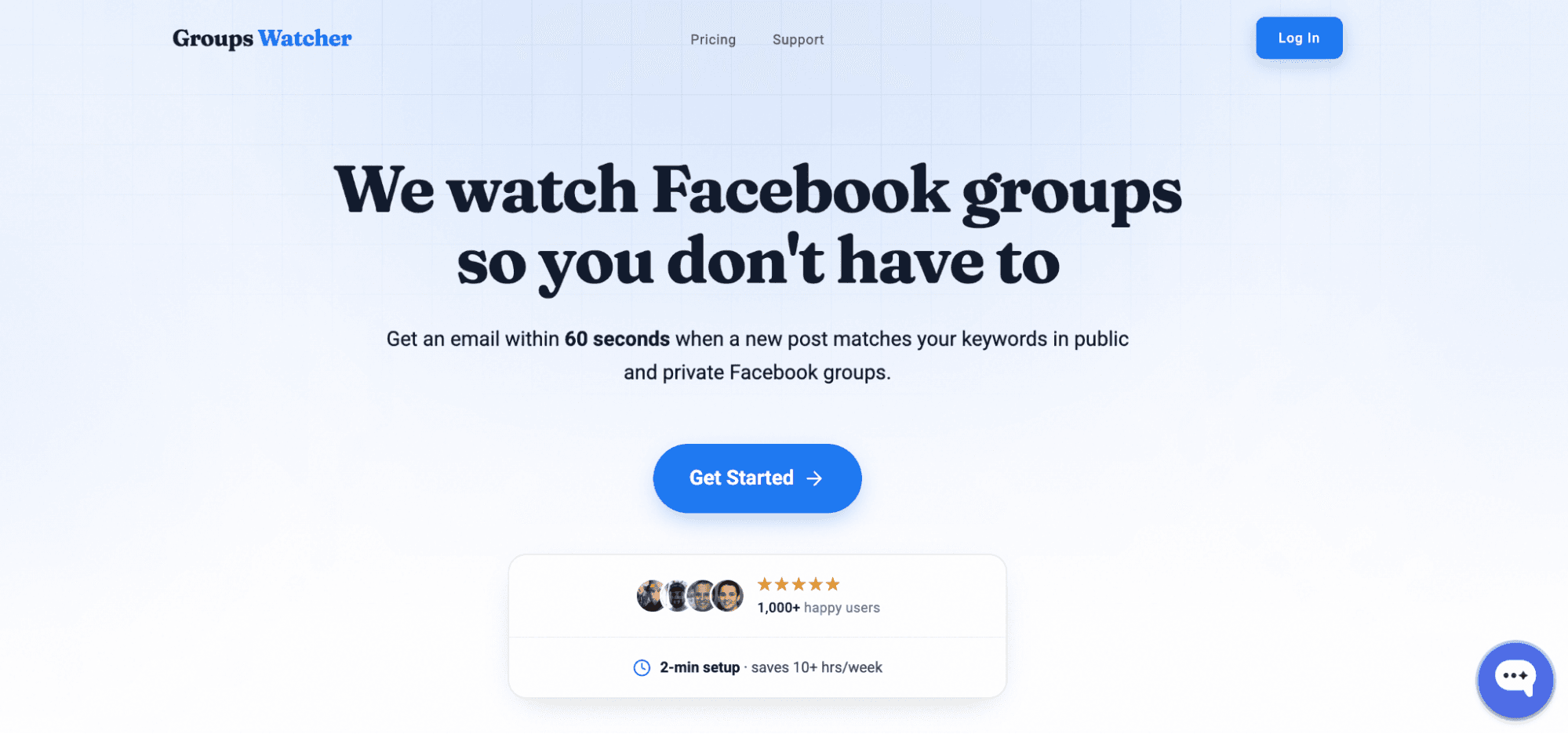
Many homeowners ask Facebook groups for recommendations before they search Google. A post like “Can anyone recommend a reliable plumber?” or “Looking for an HVAC company today” can receive several replies within minutes.
Businesses that reply early often receive the most attention. Groups Watcher helps you find those opportunities before the discussion becomes crowded.
Monitor Public and Private Facebook Groups
Groups Watcher monitors Facebook Groups for you. You don’t need to keep a browser open, leave your computer running all day, or use your own Facebook account for monitoring. Everything runs on Groups Watcher’s servers.
Simply send the Facebook Group URLs you want to monitor. It handles the monitoring from there.
The platform supports both public and private Facebook groups, even if you are not an admin or a member of those groups. That gives you access to many local communities that are difficult for most businesses to monitor on their own.
Receive Alerts in Under 60 Seconds
Many recommendation posts receive their first replies within a few minutes, and some posters stop checking once they find a business they like.
Groups Watcher sends alerts in under 60 seconds after a new post appears. You can receive every new post from selected groups or only posts that match your keywords.
You can pick phrases like “looking for,” “recommend,” “need help,” your service name, or your city. Then, you can add exclusion keywords to reduce unrelated alerts.
Alerts can arrive through email, Slack, Discord, Microsoft Teams, SMS, webhooks, and other supported channels.
Stay First With Auto Comments
Some recommendation requests ask the same questions every day. Groups Watcher lets you create predefined comment templates for those situations.
After a matching post appears, Groups Watcher can automatically publish your prepared reply on managed plans. You can greet the poster, mention your service, and invite them to contact you, all within the first few comments.
Early replies usually receive more visibility than comments added much later.
Focus on Relevant Posts Instead of Every Keyword Match
A keyword alone doesn’t always tell the whole story. Someone may mention “plumber” in a conversation that has nothing to do with hiring one.
Groups Watcher uses AI to understand the context of each post. You can choose highly relevant alerts, keyword alerts, or every new post, depending on your goals.
Companies such as TripAdvisor, leading HVAC businesses, agencies, and local service providers trust Groups Watcher because fast, relevant alerts help them join conversations before competitors do.
Looking through every new post takes more time than most businesses have. Choose keyword alerts or every new post in Groups Watcher, and focus only on the conversations you care about!
FAQs About Local Service Business Lead Generation
How to generate leads for a service business?
Use several lead sources instead of relying on one. Optimize your Google Business Profile, invest in local SEO, collect customer reviews, ask for referrals, publish helpful content, run Google Local Services Ads, and monitor Facebook groups for recommendation requests.
How much should I pay for lead generation?
There isn’t a single amount that works for every business. Your budget depends on your industry, service area, competition, and goals.
Start with a budget you can measure, track your results, and increase your spending only on channels that consistently bring profitable jobs.
How to get local business leads?
Show up where local customers already look for services. Build a complete Google Business Profile, create pages for every service area, earn recent reviews, grow your referral network, and use Groups Watcher to monitor private and public Facebook groups for new recommendation requests so you can respond early.
What is the 5-minute rule for leads?
The 5-minute rule means contacting a new lead within five minutes whenever possible. Fast replies keep prospects engaged and improve your chances of booking the job before they contact another business.
Ready to get more leads from Facebook groups?
Book a demo and see how Groups Watcher can turn Facebook groups into a lead source for your business.
Book a demo