Scraping Facebook Groups: Risks, Limits and a Safer Way to Get Leads
Get Facebook group alerts in 60 seconds.
Groups Watcher finds the leads in your Facebook groups and sends them to you in 60 seconds, before your competitors reply, without using your Facebook account. 7 day trial for $1 with full features.
Start your $1 trialScraping Facebook Groups: Risks, Limits and a Safer Way to Get Leads
If you are scraping Facebook groups, you almost certainly want one thing: to know when someone posts that they need what you sell. A bulk export of posts and members does not give you that. It gives you a stale spreadsheet, and a script that signs in through your own profile can put that profile at risk. The faster route is monitoring: you pick the groups, set the criteria, and get an alert in about a minute when a matching post appears. Groups Watcher works this way, and it never asks for your Facebook login.
TL;DR
- Scraping produces a pile of data. Leads are won by the first useful reply to a fresh post, so speed and filtering matter more than volume.
- Tools that run through your own logged-in profile expose that profile to Meta's restriction system, which can limit posting in groups and, for repeated violations, disable the account.
- US law treats scraping public pages as low risk under the main federal hacking statute, but that is not the whole legal picture, and group data often includes personal details.
- Groups Watcher monitors public and private groups without your Facebook account or credentials, scores posts with AI and sends alerts within 60 seconds to Slack, Discord, email, Teams, webhooks and CRMs.
- The trial is $1 for 7 days. The Professional plan is $99 per month, and extra groups are $2 per month per group.
Table of Contents
- What people usually mean by scraping Facebook groups
- What group data is actually reachable
- The account risk: what restriction looks like
- Is scraping Facebook groups legal in the US?
- Why a data dump loses to a fast alert
- How lead monitoring works without a login
- What it looks like in four businesses
- Scraping tools versus monitoring, side by side
- Getting started with Groups Watcher
- Perspective
- FAQ
- Sources
What people usually mean by scraping Facebook groups
The phrase covers three different jobs, and they have very different value for a business.
Exporting member lists. Names, profile links and join dates. This is the most common request and the least useful one for sales. A member list tells you who joined a group at some point. It does not tell you who needs a photographer, a roofer, a CRM or a set of coilovers this week.
Pulling post archives. Historical posts and comments, usually for research. Useful for understanding a market, but old posts are already answered or abandoned.
Catching new posts as they appear. This is the job that produces revenue. A wedding vendor wants to see "Anyone know a good DJ for a June wedding in Tampa?" while it has three comments, not thirty.
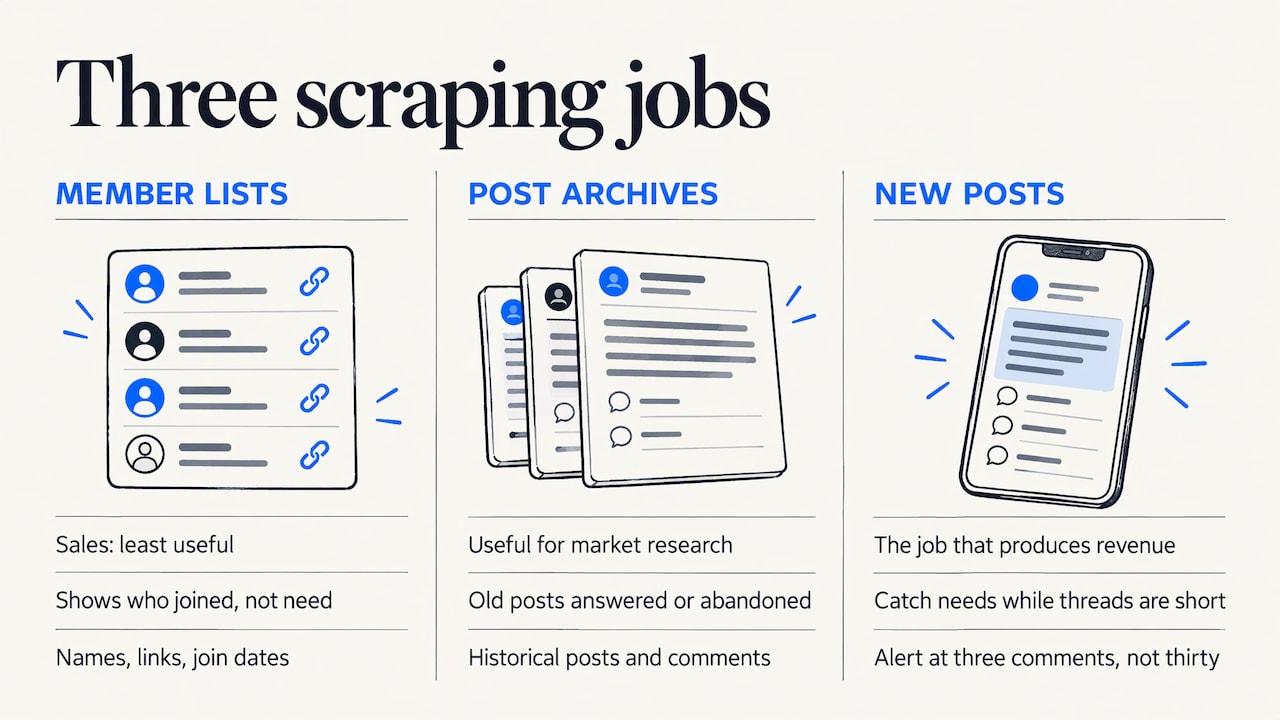
If your goal is the third one, the extraction methods built for the first two are the wrong tool. A purpose-built monitor is designed for exactly that job, and it avoids the account and data-handling problems that come with scripts.
What group data is actually reachable
Public groups can be read without joining. Private groups show their content only to members. Regardless of a group's privacy setting, the Electronic Frontier Foundation's guide to Facebook groups points out that Facebook itself can see everything posted, and that anyone with access can copy or screenshot conversations. In other words, group content is not secret, but it is also not a free-for-all you can sweep up without consequences for your account.
Meta does run an official route for bulk access, the Meta Content Library and API. It is free, but eligibility requires affiliation with an academic institution or a not-for-profit organization focused on scientific or public-interest research, so a business pursuing leads is not the intended user. Researchers have also noted that export is limited to groups above 25,000 members, which leaves the small, local, niche groups where buying conversations happen out of reach.
Get Facebook group alerts in 60 seconds.
Groups Watcher finds the leads in your Facebook groups and sends them to you in 60 seconds, before your competitors reply, without using your Facebook account. 7 day trial for $1 with full features.
Start your $1 trialThat gap is the reason lead-focused businesses need a different kind of tool: one built to watch the specific groups you care about, large or small, and tell you when something relevant is posted.
The account risk: what restriction looks like
The biggest practical danger of scraping is not a lawsuit. It is losing the account you use to run your business presence, your ads and your group participation.
Meta publishes how its restriction system escalates. Under its account restriction framework, one strike is a warning, two to six strikes limit specific features such as posting in groups for a limited time, and from seven strikes upward content creation is restricted for 1, 3, 7 and then 30 days, with disablement possible for continued violations. Meta's Account Integrity policy adds that it may ask for additional information when an account is used through automated means such as scripting, and that accounts that persistently violate policy can be restricted or removed.
For a business, the practical consequences are easy to picture:
- A real estate agent loses the ability to post in the local groups where she gets referrals.
- An Airbnb host is locked out of the profile linked to his page.
- An e-commerce owner whose personal profile manages the store's page finds both tangled in a review.
The pattern behind all of these is the same: a tool acting through your login puts your login on the line. The safest design is one where your profile is never involved at all.
Is scraping Facebook groups legal in the US?
This is a question about law, not a how-to, so treat it as orientation and take specifics to a lawyer.
On the federal hacking statute, the Computer Fraud and Abuse Act (CFAA), the picture for public data is favorable. The Quinn Emanuel law firm's overview of the legal landscape of web scraping covers the key cases. In one of them, Facebook v. Power Ventures, continued access after Facebook sent a cease-and-desist letter and blocked the scraper's IP addresses was held to violate the CFAA. In another, Meta v. BrandTotal, the CFAA claim failed, but Meta still won on a separate contract claim.
The most recent big ruling is Meta v. Bright Data. In January 2024 a federal court in California granted summary judgment to the scraper on the contract claim for logged-off scraping of public data. That ruling is narrow: it concerned public data collected while logged out, and it says nothing in favor of tools that operate through a member's own logged-in session.
Two things follow for a business owner:
- "It was public" does not settle every question. Data about identifiable people, such as names, profile links and the text of their posts, raises privacy-law questions in states with consumer privacy statutes, and a bulk export multiplies that exposure.
- A tool that needs your credentials is a different situation from one that does not. Keeping your account out of the picture removes the most immediate risk, the one to your own profile.
A monitor that alerts you to individual posts you then answer yourself keeps your data footprint small: you hold the posts that matter, not a database of thousands of strangers.
Why a data dump loses to a fast alert
A scraped export, even a perfect one, has three weaknesses for anyone selling something.
It is slow. Exports run on a schedule. By the time you read the file, the person who asked for a recommendation has picked one.
It is noisy. Most group posts are memes, promotions and chatter. You still have to read all of it to find the five posts that matter.
It is generic. A list of members says nothing about intent. A post that reads "where can I buy a cold air intake for my F-150?" is intent in its purest form.
Monitoring flips each of these. Alerts arrive as posts appear, filters cut the noise, and the unit of value is the post that mentions your product category, your competitor or your service area. For a closer look at how that works on open groups, see our guide to public Facebook group monitoring and catching leads in 60 seconds.
How lead monitoring works without a login
Here is the routine, step by step, and what Groups Watcher does at each stage.
Step 1: Choose the groups where buyers ask
You need the groups where your customers ask for recommendations, not the biggest groups in your industry. A wedding vendor wants local planning and "engaged in [city]" groups. A parts store wants model-specific owner groups. A B2B software brand wants communities where operators complain about their current tools.
Finding them by hand means searching, joining, waiting for approval and guessing. Groups Watcher includes an AI-driven group finder that suggests groups for your niche, and you can swap groups at any time, so a group that stops producing leads does not lock you in.
Step 2: Define what a lead looks like
Write down the phrases a buyer would use. Think in three buckets:
- Asking for what you sell: "looking for", "recommend", "anyone know a", "where to buy".
- Naming a competitor: a brand name plus words like "alternative", "cancel" or "problem with".
- Describing the problem you solve: the symptom, not your product name.
In Groups Watcher you set these as custom filters, and AI lead scoring ranks the posts that match so the high-intent ones stand out. It reads posts in any language, which matters in groups serving mixed-language communities.
Step 3: Route alerts to where your team already works
A lead alert that lands in an inbox nobody checks is a lost lead. Groups Watcher sends alerts through Slack, Discord, email, Teams, webhooks and CRM integrations, so a match can appear in the channel your sales or service team watches all day. Our walkthrough of Slack, Discord, email and CRM alert integrations shows the options in detail, and the instant notification setup guide covers the first configuration.
Step 4: Reply fast, as a person
Alerts arrive within 60 seconds of a post matching your criteria. That head start is the whole advantage: being among the first helpful replies puts you ahead of the competitor who finds the thread tomorrow. Answer the question first, mention what you do second, and keep the tone of a neighbor, not an ad.
Step 5: Prune and widen
After a couple of weeks, look at which groups and keywords produced real conversations. Drop the quiet groups, add similar ones, and tighten filters that let through noise. Extra groups cost $2 per month each, so widening coverage is a small, predictable decision.
What it looks like in four businesses
A wedding photographer. Her filters watch for "photographer", "engagement shoot" and her county name in local wedding groups. An alert shows a bride asking for recommendations for a date in October. She replies within minutes with a portfolio link while the thread is still short.
A real estate agent. He monitors neighborhood and relocation groups for phrases such as "moving to", "looking for a realtor" and "thinking of selling". Each match is a conversation starter with someone who has just said they need an agent. More ideas for service businesses are in our piece on Facebook lead alerts for local service businesses.
A performance parts store. Truck and car owner groups are full of questions like "where do I find an aftermarket tune for my Silverado?" The store sets part names and model names as filters and gets pinged the moment the question appears.
A B2B software brand. The team tracks posts that name a rival tool alongside words of frustration, plus questions starting with "is there a tool that". Alerts go straight to a Slack channel the sales team already uses. To extend this to reputation, read how to monitor brand mentions on Facebook.
Scraping tools versus monitoring, side by side
| What you need | Bulk scraping through your account | Groups Watcher |
|---|---|---|
| Needs your Facebook credentials | Typically yes | No |
| Risk to your own profile | Exposed to restriction systems | Your profile is not involved |
| Speed to a new post | Depends on run schedule | Alerts within 60 seconds |
| What you receive | Large exports to sift through | Scored, filtered, matching posts |
| Where results arrive | A file | Slack, Discord, email, Teams, webhooks, CRM |
| Languages | Often limited | Any language |
Getting started with Groups Watcher
The 7-day trial costs $1 one-off, which is enough time to connect a few groups, set your filters and see what real alerts look like for your niche. After the trial, the Professional plan is $99 per month and includes monitoring, the AI group finder and unlimited lead scoring and alerts. Each extra group is $2 per month. You can see everything on the pricing page, or read more about the approach on our Facebook social listening page.
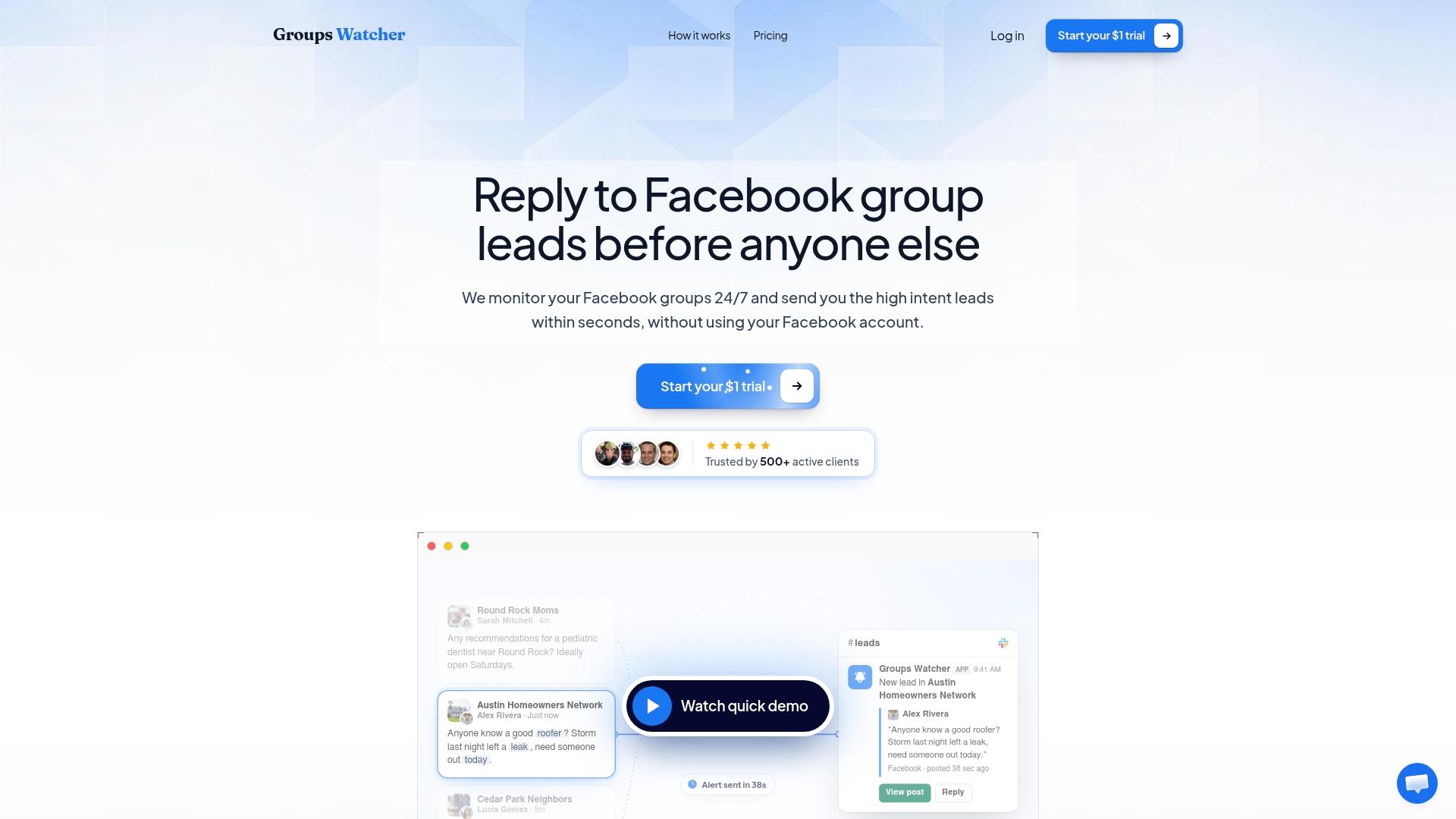
If you are choosing between monitoring tools, our comparison with Devi AI lays out the differences feature by feature.
Perspective
Most of the people who contact us start with the word scraping and end up wanting something simpler: to be the first helpful voice when a buyer asks a question. That is a timing problem, not a data-collection problem.
We built Groups Watcher so the account you run your business through never has to be part of the equation. There are no credentials to hand over, so there is nothing for a restriction to land on. The tool watches the groups you select, scores each post for intent with AI, and tells you within 60 seconds when one matches.
We think this is the right shape for lead generation in Facebook groups: small, targeted, fast and in your language, whatever it is. You decide the groups and the filters. You keep the conversation. The alert simply makes sure you are early.
Groups Watcher Team
FAQ
Can scraping Facebook groups get my account banned?
Tools that act through your logged-in profile put that profile in front of Meta's enforcement system, which escalates from warnings to feature limits such as posting in groups, and to disabling for continued violations. Groups Watcher does not use your Facebook account or credentials, so there is no profile of yours to restrict.
Is it legal to scrape public Facebook groups in the US?
Under the federal CFAA, courts have been friendlier to collecting public data while logged out, as the 2024 Bright Data ruling shows, but other legal questions, including privacy laws covering personal information, can still apply. For anything beyond monitoring individual posts, ask a lawyer who handles data and privacy matters.
Can I monitor private Facebook groups for leads?
Yes. Groups Watcher monitors both public and private groups for matching posts, and it does so without access to your Facebook account. You choose the groups, and you can swap them whenever you like.
How fast will I know when someone asks for my product?
Groups Watcher sends an alert within 60 seconds of a post in a selected group matching your criteria. Alerts can go to Slack, Discord, email, Teams, webhooks or a CRM, so your team sees them where they already work.
What does it cost?
The trial is $1 for 7 days. The Professional plan is $99 per month, and each extra group is $2 per month. Current details are on the pricing page.
Sources
- Facebook Groups: Reducing Risks, EFF Surveillance Self-Defense
- Meta Content Library and API, Meta Transparency Center
- The Post-API Age of Social Media Data Access, Public Opinion Quarterly
- Restricting accounts, Meta Transparency Center
- Account Integrity, Meta Transparency Center
- The Legal Landscape of Web Scraping, Quinn Emanuel
- Meta Platforms, Inc. v. Bright Data, court order (N.D. Cal., 2024)
Recommended
Stop checking Facebook groups by hand.
Groups Watcher finds the leads in your Facebook groups and sends them to you in 60 seconds, before your competitors reply, without using your Facebook account. 7 day trial for $1 with full features.