Facebook Group Rental Inquiries: How to Catch Them First
Get Facebook group alerts in 60 seconds.
Groups Watcher finds the leads in your Facebook groups and sends them to you in 60 seconds, before your competitors reply, without using your Facebook account. 7 day trial for $1 with full features.
Start your $1 trialFacebook Group Rental Inquiries: How to Catch Them First
The fastest way to capture rental inquiries from Facebook groups is to stop checking groups by hand and have every new post screened against your criteria, with an alert sent to the place you already work. A renter who posts "looking for a 2-bedroom near downtown, $2,000 budget" is asking several landlords at once, and the first useful reply usually wins the conversation. Groups Watcher monitors the groups you choose, scores posts for intent and sends an alert within 60 seconds, without needing your Facebook login.
This guide is for landlords, property managers, real estate agents, short-term rental hosts and anyone else who rents something out and wants the person asking for it to find them first.
TL;DR
- Rental demand in Facebook groups is real and fast-moving: housing groups in big cities draw hundreds of posts a day, so manual scrolling misses most of them.
- A high-intent inquiry names a place, a budget, a move-in date or a unit size. Build your filters around those four signals.
- Reply within minutes, with specifics the renter can verify, and move the chat to a call, a showing or your booking page.
- Log every lead with its source group, post link, status and outcome so you can see which groups pay off.
- Groups Watcher sends alerts in under 60 seconds to Slack, Discord, email, Teams, webhooks or your CRM, with no Facebook credentials required.
Table of Contents
- Why rental inquiries in Facebook groups go cold so quickly
- What a high-intent rental inquiry looks like
- Choosing the groups worth watching
- How to capture inquiries without missing any
- Why not just watch the groups yourself?
- Replying in a way that earns the showing
- Qualifying and tracking what you capture
- A worked example
- Start catching rental inquiries today
- FAQ
- Sources
Why rental inquiries in Facebook groups go cold so quickly
Housing groups are crowded. A Business Insider report on New York renters describes an agent whose network of four housing groups grew to nearly 300,000 members, with moderators handling hundreds of posts a day for roommates, sublets and apartments. His advice to renters was to cast a wide net across apps, Facebook and less conventional channels.
That last point explains the speed problem. A renter who casts a wide net is messaging several people at once. By the time you open Facebook in the evening, scroll past 200 posts and find the one that fits your vacancy, the renter has often already booked a showing elsewhere.
Three things make rental inquiries different from most lead types:
- They are time-boxed. A lease ends on a date, a job starts on a date, a trip begins on a date. The renter will not wait.
- They are public. Anyone in the group can reply, so the first response sets the tone.
- They are unstructured. Nobody fills in a form. The inquiry arrives as a sentence in a post, mixed in with listings, roommate searches and memes.
The work, then, is to find the right groups, recognize the right posts and respond before the window closes.
What a high-intent rental inquiry looks like
Not every post that mentions "apartment" is a lead. A listing from another landlord, a roommate swap and a general question about neighborhoods all contain the same words. A real inquiry has a few signals you can write down in advance.
The four signals
- Place. A city, neighborhood, school district or street. "Looking in Astoria or Long Island City" is far stronger than "looking in NYC."
- Budget. A number or range. Someone who states $1,800 to $2,200 has already done the math.
- Timing. A move-in date, a lease end or a trip window. Urgency raises intent.
- Unit or stay details. Bedrooms, pets, parking, furnished or unfurnished, number of guests, length of stay.
A post with three or four of these is worth an immediate reply. A post with one is worth a look when your pipeline is quiet.
Get Facebook group alerts in 60 seconds.
Groups Watcher finds the leads in your Facebook groups and sends them to you in 60 seconds, before your competitors reply, without using your Facebook account. 7 day trial for $1 with full features.
Start your $1 trialPhrases that signal intent
People phrase requests in repeatable ways. Build a keyword list from the verbs and nouns they use:
- "looking for", "anyone know of", "need a place", "in search of"
- "studio", "1BR", "2 bed", "sublet", "lease takeover", "furnished", "month-to-month"
- "pet friendly", "no broker fee", "move in by", "available now"
- For short-term rentals: "staying for", "dates", "for a wedding weekend", "traveling with"
Write two lists: phrases that should trigger an alert, and phrases that should suppress one (for example "for rent", "available", "DM me for details" when you only want seekers, not other landlords).
Other people asking for what you rent
Rentals reach beyond apartments. A party-equipment rental company, a vacation home host, a car or truck rental shop, a wedding venue and a commercial landlord all see the same pattern: someone posts a request, and the first credible reply gets the booking. The same four signals apply, with the product swapped in. A wedding vendor watches for "date", "guest count" and "venue". An Airbnb host watches for "dates", "guests" and the destination.
Choosing the groups worth watching
A tool can only alert you on posts in groups you have told it to watch, so group choice drives results. A service-business guide from Natural Poster suggests searching Facebook for your city and nearby towns together with words like "community," "residents," "buy sell trade" and "recommendations," and keeping groups that are local, active daily and relevant to your buyers. For rentals, add these:
- Housing and sublet groups for your metro area and neighboring suburbs.
- Neighborhood and town groups, where people ask "does anyone know of a place?" among other questions.
- Employer, university and relocation groups: new hires, interns and students need housing on a deadline.
- Event and travel groups for your destination, if you host short stays.
- Niche groups: pet owners, nurses, remote workers, military families.
Two habits keep the list useful. First, rank groups by how many genuine inquiries they produce per week, not by size. A 3,000-member neighborhood group can beat a 60,000-member city group full of listings. Second, rotate. Groups Watcher lets you swap groups at any time, so a group that only produces noise can be replaced the same day, and its AI group finder suggests relevant groups you may not have thought of.
If you also want people to find you outside Facebook, pairing group monitoring with real estate SEO services builds visibility in search while the alerts handle the people already asking in groups.
How to capture inquiries without missing any
The goal is a short, reliable path from a post being published to you reading it. Here is the routine.
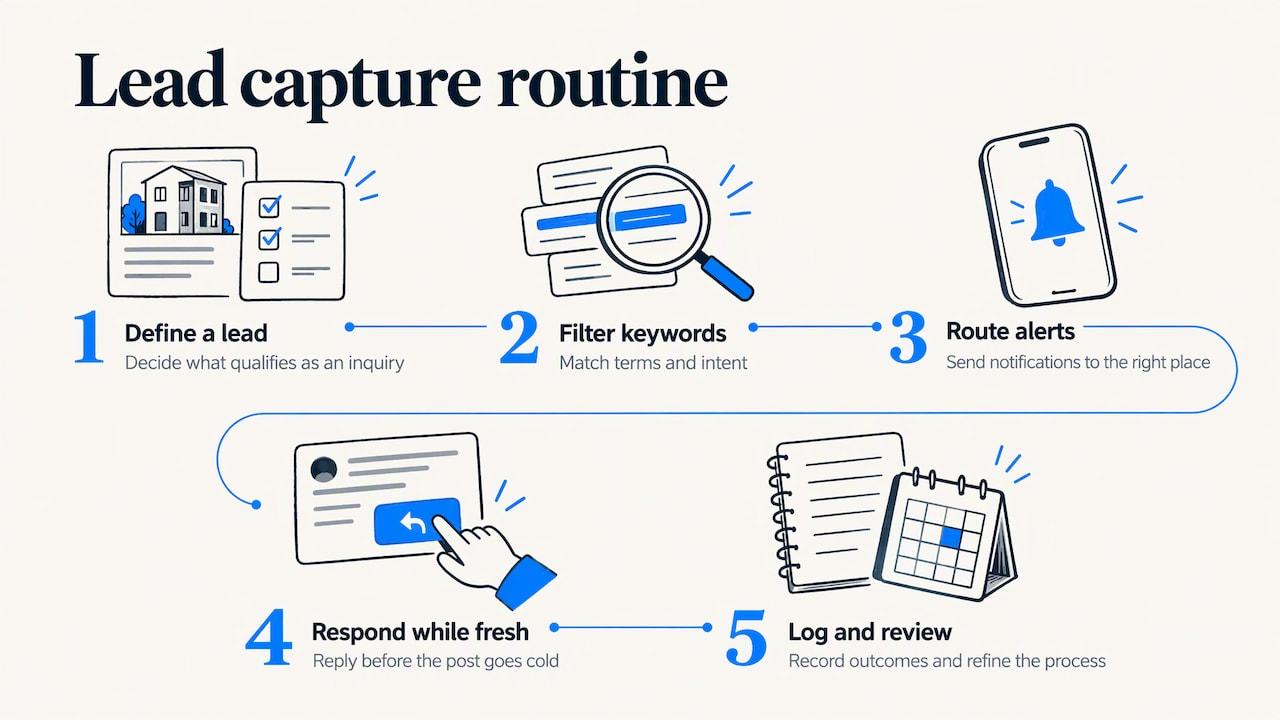
Step 1: Define what counts as a lead
Write down your property or service in plain terms: unit types, areas, price range, minimum stay, pets policy. This becomes your filter. If your studios start at $1,600, a request for "something under $1,000" is not worth an alert.
Step 2: Set keyword and intent filters
Enter the phrases from the previous section. Groups Watcher combines customizable filters with AI lead scoring, so posts that read like real requests rank above vague chatter. The scoring is unlimited on the Professional plan, so volume does not cost extra.
Step 3: Route alerts to where you already work
An alert is only useful if you see it. Groups Watcher sends alerts through Slack, Discord, email, Microsoft Teams, webhooks and CRM integrations, 10+ channels in total. A leasing team can share one Slack channel so whoever is free takes the lead. A solo landlord can use email on a phone. If you want the full walkthrough, the setup guide for Facebook group notifications covers it.
Step 4: Respond while the post is fresh
The Fencing Marketers, writing about local services, recommend replying only to posts from the last 24 to 48 hours; older posts rarely convert. For rentals, tighten that to hours. Alerts that arrive within 60 seconds of the post make a reply in the first few minutes realistic, even while you are showing another unit.
Step 5: Log and review
Capture each lead in a spreadsheet or your CRM (details below), then review weekly which groups and filters produced the best leads and adjust.
Why not just watch the groups yourself?
Manual checking works with one small group. It breaks down when you cover ten, because the work is repetitive and the timing is unpredictable. Posts land at 11 p.m., on weekends, during showings. Facebook's own notifications surface only some activity and carry no scoring or filter logic, so you end up reading everything.
Automated monitoring changes three things:
- Coverage. Every post in every watched group is screened, including public and private groups.
- Focus. You see only posts that match your criteria, ranked by intent.
- Safety of your profile. Groups Watcher works without access to your Facebook account and without your credentials, so your personal profile is not part of the setup.
It also supports posts in any language, which matters in cities where renters post in Spanish, Chinese, Russian or Portuguese as readily as in English.
Replying in a way that earns the showing
Speed gets you into the conversation. The content of your reply decides whether it continues.
Lead with specifics
Do not paste the same message under every post. Match what they asked. If they wrote "2BR, $2,400, pets, move-in March 1," answer with the one unit that fits: rent, availability date, pet terms and a link to photos or a booking page. A reply that repeats their criteria back shows you read the post.
Make it verifiable
Renters are cautious. The FTC's guidance on rental listing scams tells renters to walk away if anyone pressures them to decide quickly, and describes scammers collecting deposits and personal details for homes that do not exist. Write your reply for that wary reader: give the address or cross streets, offer a showing or live video tour, say how your application works, and never ask for money or ID in a public comment. Trust is a conversion tool.
Move to a private conversation carefully
A short public reply ("Sent you a message with details") followed by a direct message is the common pattern. BrandJet's compliance overview notes that Messenger promotional messages require permission and a 24-hour window after the user starts the conversation, so the sensible approach is to answer their question first, give something useful and let the renter reply before you offer anything further. Keep messages personal rather than identical copies sent to many people.
Offer an easy next step
A time slot for a showing, a calendar link or a phone number beats "let me know if interested." One clear action per message.
Qualifying and tracking what you capture
A lead you cannot find again is a lead you lose. Keep the record light but consistent.
| Field | Why it matters |
|---|---|
| Group name | Shows which groups are worth keeping |
| Post link | Lets you return to the original request |
| Date and time posted | Measures your response time |
| Budget, area, move-in date | Qualifies fit in seconds |
| Status (new, contacted, showing set, leased, lost) | Shows where leads stall |
| Outcome and revenue | Ties groups to money |
Qualify with three questions: Does the budget fit a unit you have? Does the timing match your availability? Is there a clear reason they chose your area? A lead failing any of the three goes to a "nurture" status, not the trash: vacancies change.
For a deeper look at structuring this, see the guide to Facebook group lead tracking, and for the wider monitoring picture, the Facebook group lead monitoring guide.
Track three numbers monthly: leads per group, median minutes from post to your reply, and leads that became showings or bookings. The second number is the one you control most directly.
A worked example
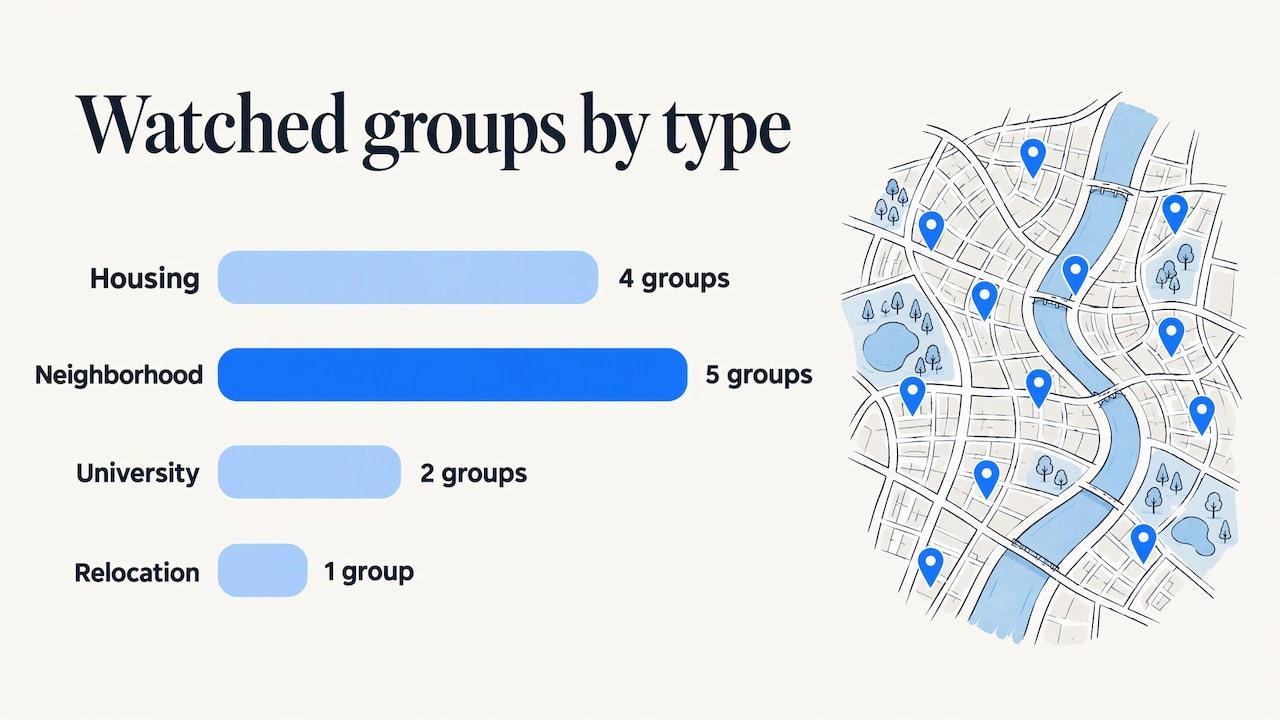
Say you manage six apartments in a mid-sized city and watch twelve groups: four housing groups, five neighborhood groups, two university groups and one relocation group.
Your filters: "1BR", "2BR", "looking for", "need a place", "sublet", "lease", with the area names of your neighborhoods, and a suppression list for "for rent" and "available".
A post appears at 9:42 p.m.: someone starting a job downtown asks for a pet-friendly one-bedroom under $1,900 from the first of next month. The alert reaches your phone by email at 9:43. You reply publicly in two minutes with one sentence, send a direct message with the unit's rent, pet terms, photos and two showing slots, and log the lead as "contacted." The following morning the renter picks a slot. A week later you check the log and see the university groups produce half your showings, so you swap two quiet neighborhood groups for two more campus-area groups.
Nothing in that sequence required scrolling. The only work was replying and refining.
Our view: speed and safety beat volume
We built Groups Watcher around one observation: the rental inquiry is public, but the advantage goes to whoever sees it first and answers well. That is why alerts arrive within 60 seconds, why AI lead scoring ranks posts by intent instead of dumping every keyword match on you, and why every plan works without your Facebook account or credentials.
We think a landlord, agent or host should spend their time on conversations, not on watching feeds. Custom filters let you describe your unit in the way renters describe their search. Alerts go to Slack, Discord, email, Teams, webhooks or your CRM, so the lead lands in the workflow your team already uses. Supporting every language means a request is a lead no matter how it is written. Swapping groups whenever you like means your coverage follows the market.
The renters who ask in groups are ready to act. Our job is to make sure you hear them in time.
Groups Watcher Team
Start catching rental inquiries today
Groups Watcher is a subscription service. The Professional plan is $99 per month and includes monitoring, the AI group finder, unlimited lead scoring and alerts. Additional groups are $2 per month per group. You can begin with the 7-day trial for $1 and watch real posts from your own groups arrive in your channel.
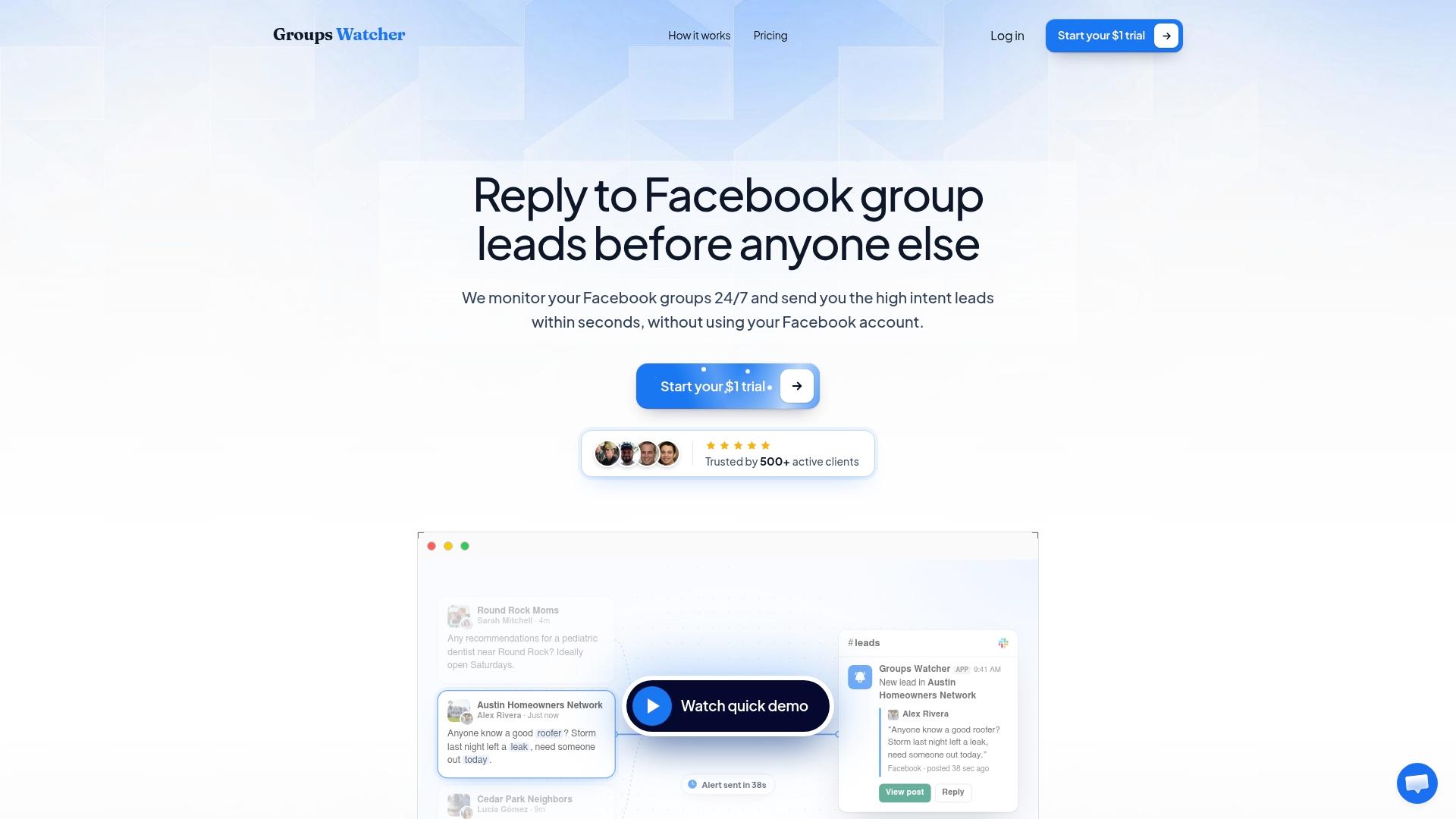
See the plan details on the pricing page, or read how Groups Watcher works for real estate agents if you list, lease or manage property.
FAQ
Is Facebook a good place to find rental inquiries?
Yes. Housing and neighborhood groups are where many renters post exactly what they want, with budget, area and dates. The difficulty is volume, since big groups can see hundreds of posts a day. Filtering and instant alerts turn that volume into a short list of real requests.
How fast do I need to reply?
As fast as you can, ideally within minutes. Renters usually contact several landlords at once, and a prompt, specific reply stands out. With alerts sent within 60 seconds of the post, you can respond while the thread is still near the top of the group.
Do I need to give a tool my Facebook login?
Not with Groups Watcher. It monitors groups without access to your Facebook account and without your credentials, so you set up the groups and filters and receive alerts in the channel of your choice.
What should I say in my first reply?
Answer what the renter asked. Mention the unit that fits their budget and dates, give a verifiable detail such as the neighborhood or a showing option, and offer one next step. Keep payment and personal documents out of public comments and out of the first message.
Can I use this for short-term rentals or other rental businesses?
Yes. The same approach works for vacation rentals, event spaces and equipment rentals. Replace the unit signals with dates, guest count, location and length of stay, and watch the travel, wedding and local community groups where those requests appear.
Sources
- New York City Renters Are Finding New, Creative Ways to Search (Business Insider)
- Get Local Leads From Facebook Groups: A Service Business Guide (Natural Poster)
- Rental Listing Scams (FTC Consumer Advice)
- Facebook Outreach Compliance Rules (BrandJet)
- How to Use Facebook Groups to Generate More Fencing Leads (The Fencing Marketers)
Recommended
Stop checking Facebook groups by hand.
Groups Watcher finds the leads in your Facebook groups and sends them to you in 60 seconds, before your competitors reply, without using your Facebook account. 7 day trial for $1 with full features.